How an End-to-End Logistics Management Solution Connects Mining from Pit to Port
Pratyush Bhowmik
•
October 26, 2026
Digital Transformation
A mining operation can tell you where its trucks are. It can tell you how much material the plant has produced, what is sitting in stock and what has passed through the weighbridge. It may even have a system showing the latest vessel schedule at the port.
Yet, ask a different question — “Will we deliver the right material to the customer on time?” — and things can become much less straightforward.
Someone may need to check production. Another person may call the logistics team. Someone else may confirm inventory. The transporter may have a different update, while the commercial team works from the latest shipment commitment.
The information exists. The problem is that it does not always exist in one connected operational picture.
This is where mining logistics management becomes more than transportation tracking. An effective logistics management solution for mining connects material, inventory, orders, transport, warehouses, ports and customer commitments across the value chain.
The objective is simple: know what is happening, understand what it means downstream and act while there is still time to change the outcome.
What Is Mining Logistics Management?
Mining logistics management is the planning, coordination and monitoring of material, inventory and transportation activities from the mine through processing, stockyards, road or rail networks and ports to the final customer.
Mining makes this particularly challenging because material moves through several operational stages and often involves multiple transport modes, systems, teams and external partners.
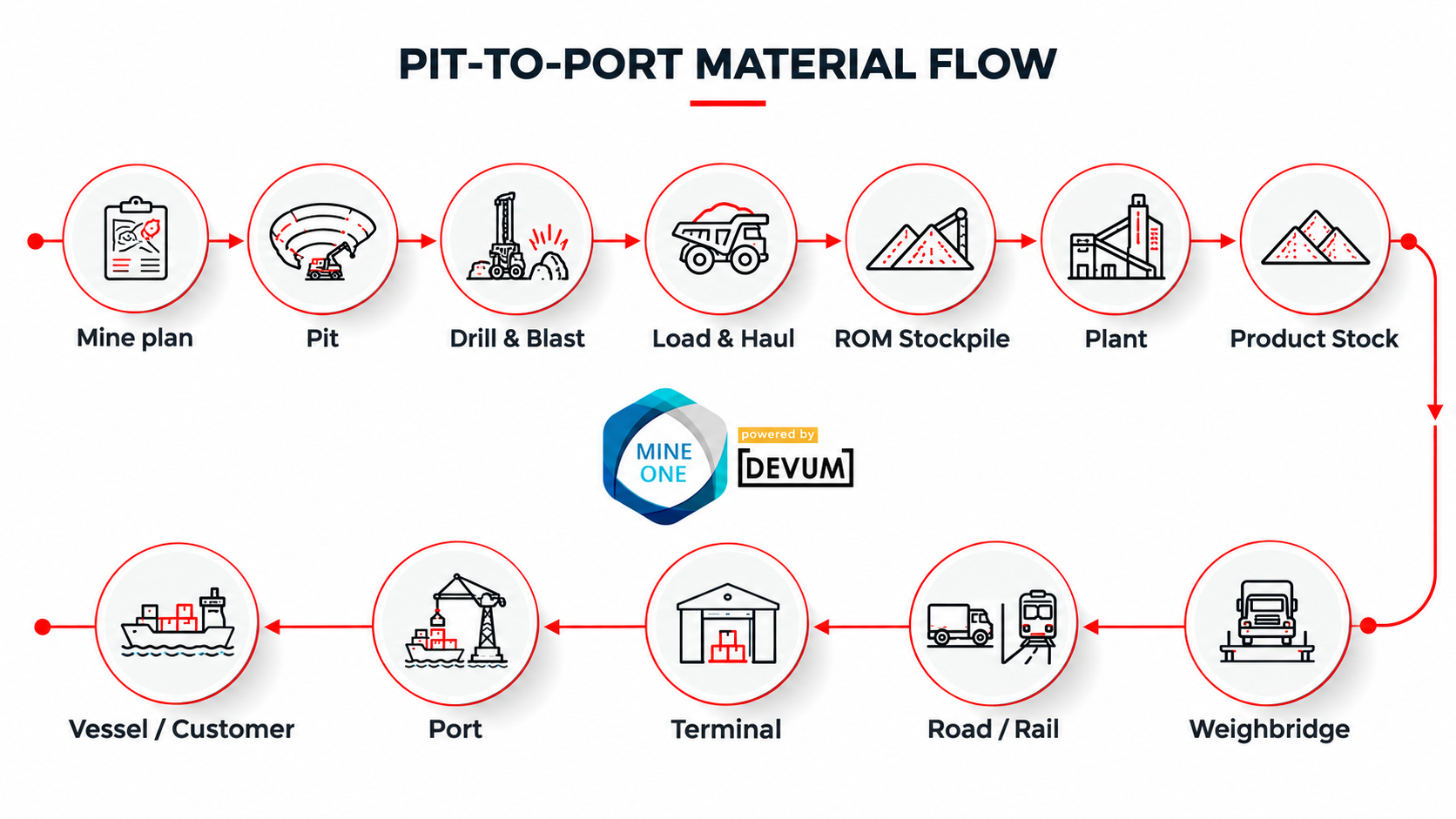
A typical journey can include:
Mine plan → Pit → Drill & Blast→ Load & Haul → ROM Stockpile → Plant → Product Stock → Weighbridge → Road/Rail → Terminal → Port → Vessel/Customer
Each stage may have its own processes and technology. Fleet systems monitor vehicles. Production systems record output. Weighbridges capture tonnes. ERP systems manage commercial transactions. Laboratory systems hold quality information. Port and shipping systems track vessel activity.
Individually, these systems can provide excellent visibility.
The challenge begins when the information is handed off from one system to another.
A recent Reactore webinarhighlighted this distinction between local visibility and end-to-end visibility. A fleet system can tell you whether a truck is loaded. A production system can tell you whether the crusher is running. But neither necessarily tells you what that event means for the shipment leaving the port or the customer commitment behind it.
That is the real challenge in mining logistics: connecting activity to outcome.
Why Does Logistics Management Matter in Mining?
Mining logistics management matters because production only creates value when the right material reaches the right destination, at the right time, in the right condition and at an acceptable cost.
A delay or error in one part of the chain can quickly become a problem somewhere else.
Imagine a shipment with a fixed loading window. Production is running slightly below plan. At the same time, rail capacity is fixed and inventory is tighter than expected.
Individually, none of these events may look critical.
Together, they can put the entire shipment at risk.
This is why pit-to-port must be one connected operating system rather than a collection of departments. Although mine planning, hauling, processing, logistics, port operations and reconciliation may sit with different teams, the material itself moves through one continuous journey.
The weakness often appears at the hand-off.
Operations may believe logistics is the constraint. Logistics may see production as the problem. Commercial may question inventory. Finance may be waiting for reconciliation.
Each team may be looking at accurate information. They simply do not have the same context.
An end-to-end logistics management solution addresses this gap by connecting these events and giving teams a shared view of the material journey.
How Does Pit-to-Port Logistics Work?
Pit-to-port logistics connects the movement of material from its source through mining, processing, stockpiling, transportation and port operations to the final shipment or customer.
The important part is continuity.
Every physical movement should create a corresponding digital event. Material moves from the pit to a stockpile, from the stockpile to the plant, from the plant to product stock, and then through road or rail logistics to a terminal and port.
The digital record should move with it.
This creates a digital thread across the value chain. It provides continuity around where material came from, where it is now, how much is available, what it has been committed to and whether the shipment remains on schedule.
Here's a practical scenario that we have encountered: 55,000 tonnes are committed to a customer shipment, the vessel loading window opens in six days, rail capacity is fixed and plant availability is under pressure.
At that point, management needs answers from across the operation:
Is the mine producing enough material at the required grade?
Are trucks achieving the required rate?
Is plant output on target?
Is enough saleable inventory available?
Are road and rail movements keeping pace?
Will enough material reach the port before loading?
Where is the binding constraint?
No single fleet, production or ERP system can answer all of those questions.
That is precisely why pit-to-port optimisation needs a connected approach.
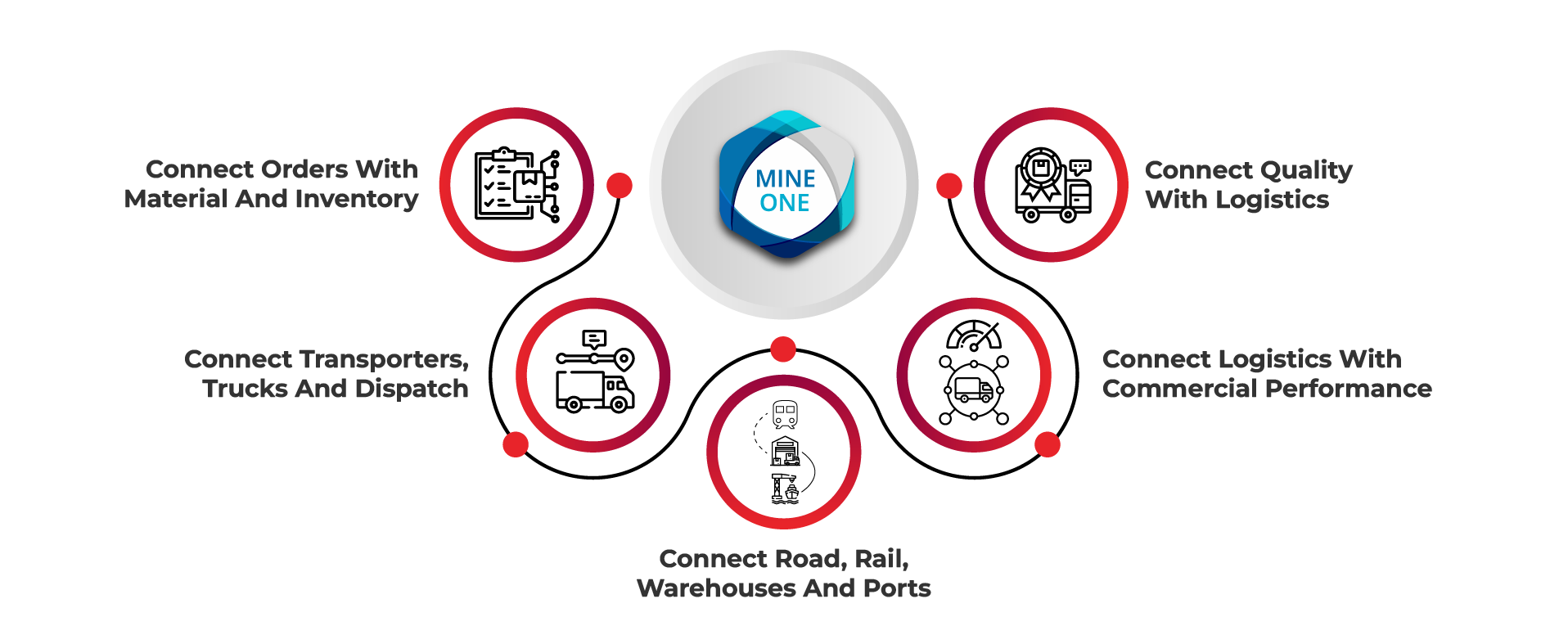
How Does an End-to-End Logistics Management Solution Connect the Chain?
A mining logistics management solution connects the operational events that sit between an order and its final delivery.
1. Connect Orders with Material and Inventory
The journey should begin with what the business needs to fulfil, not simply what a truck is moving. Linking customer orders to available product, stock locations and delivery commitments strengthens inventory visibility in mining and reduces manual reconciliation of what is available against what is already committed.
2. Connect Transporters, Trucks and Dispatch
Mining transportation management is more than vehicle location. Bringing transporter allocation, truck assignment, trip notifications and status updates into one workflow makes fleet tracking part of the wider logistics process. A GPS system tells you where a truck is; integrated mining logistics software tells you why that truck matters to the shipment.
3. Connect Road, Rail, Warehouses and Ports
Multimodal mining logistics depends on every hand-off. A truck delay affects rail loading; a rail delay affects terminal inventory; a stock shortage affects vessel loading. Connecting warehouse, road, rail, port and vessel activity as one journey turns mine-to-port logistics from a transport plan into a connected flow of material and information.
4. Connect Quality with Logistics
Tonnes at the port are not enough; the material must meet specification. With quality data, laboratory results and Certificates of Analysis on the same digital thread, teams can ask: Is the material available, compliant, moving, and still aligned with the customer’s requirement?
5. Connect Logistics with Commercial Performance
Transport expenses, transporter costs, order value and delivery performance all shape shipment economics. Connecting them shows what material movement means financially — a key step towards mining logistics optimisation.
What Should a Mining Logistics Management System Include?
A capable mining logistics management system should cover more than fleet tracking.
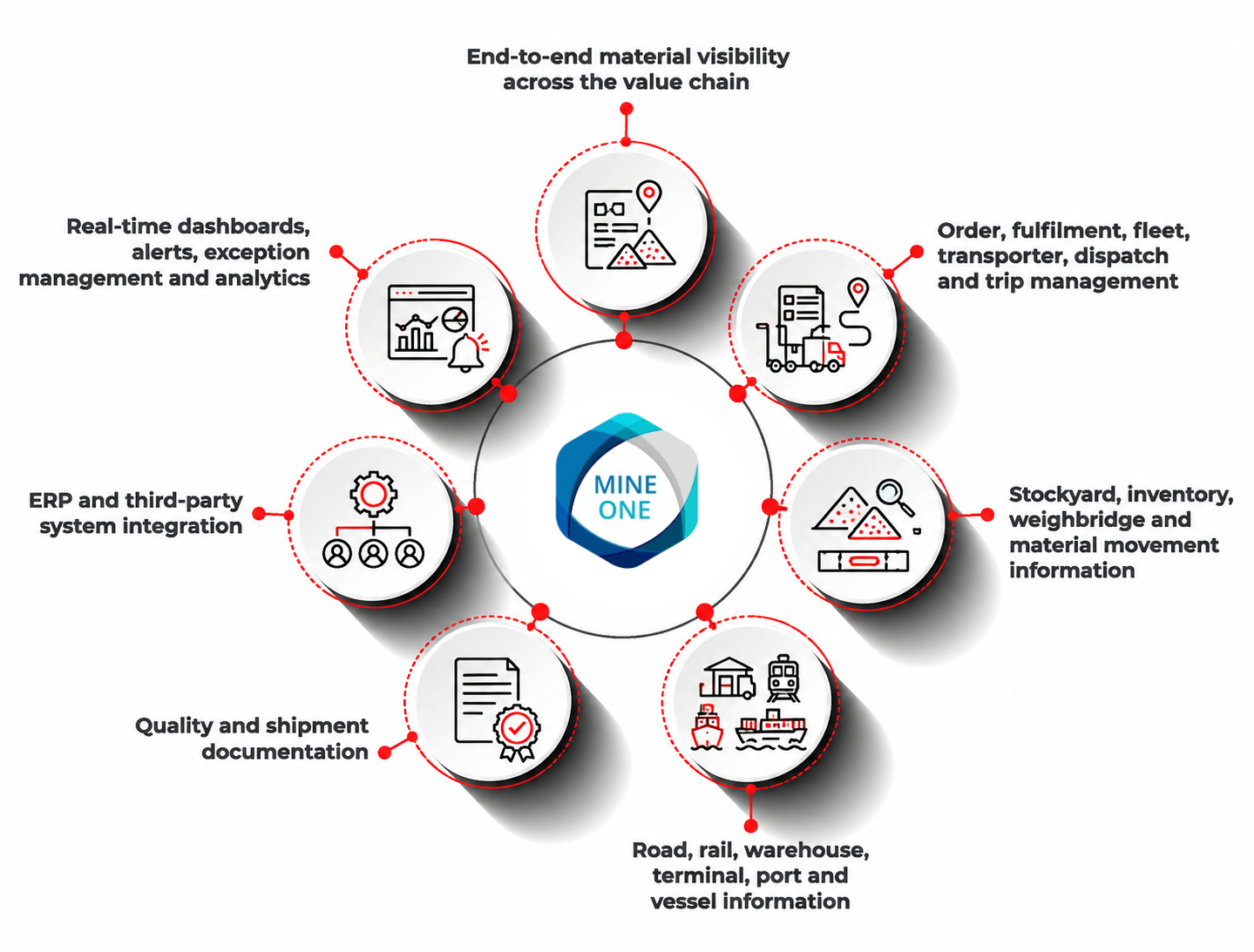
At a minimum, it should consist of:
End-to-end material visibility across the value chain
Order, fulfilment, fleet, transporter, dispatch and trip management
Stockyard, inventory, weighbridge and material movement information
Road, rail, warehouse, terminal, port and vessel information
Quality and shipment documentation
ERP and third-party system integration
Real-time dashboards, alerts, exception management and analytics
A mine does not need to implement everything at once. Consistent with the MineOne® platform philosophy, the aim is to build a useful digital thread around the operational problem that needs solving, on a shared operational data model, and expand progressively.
Why Integration Matters More Than Another Logistics Tool
Most mining companies already have a substantial technology estate.
They may use fleet management, GPS and telematics, ERP, mine planning, maintenance systems, SCADA, weighbridges, production systems and logistics or port platforms.
The answer, therefore, is not always another standalone system.
This makes a strong case for “connect, don't replace”. Existing technology represents significant operational and commercial investment. The priority should often be to orchestrate that investment and connect the information flowing between systems.
Think about the individual pieces; A GPS system, a weighbridge, an ERP system, a laboratory management system, and a port system.
The real value comes when those events can be connected. That is the role of an integrated logistics management solution.
From Visibility to Action with Mining Logistics Automation
Visibility on its own is not enough.
If a dashboard tells a manager that a shipment is at risk, but the manager still needs to call three teams and reconcile four spreadsheets, the organisation has visibility but not much control.
This is where mining logistics automation and exception management become valuable.
The objective is to identify the events that need attention and connect them to the operational context around them.
A plant disruption, for example, should not remain a plant issue. If it affects production, it may affect inventory. If inventory falls below the required level, it may affect rail dispatch. That may then affect port readiness and, ultimately, the customer commitment.
The earlier the connection is made, the more options the business has.
This is the difference between monitoring what happened and managing what happens next.
Connecting Mining Logistics with MineOne®
MineOne® provides the operational layer that brings systems, equipment, people and processes into a shared operating picture. Its role is not to replace every system already used by a mine. Instead, it connects existing systems and third parties while providing configurable workflows, visibility, alerts, exception management and decision support.
For mining logistics, that means connecting capabilities such as fleet and dispatch, inventory, sales and distribution, reporting, alerts and systems integration around a common operational context.
The broader MineOne® platform follows the same principle across mining operations: a fleet event can affect production, production can affect inventory, inventory can influence logistics, and logistics can feed into shipment and commercial visibility.
That is what makes an end-to-end logistics management solution more useful than a collection of disconnected tools.
From Pit to Port — and All the Way to the Buyer
A recent pit-to-port-and-buyer deployment illustrates the value of this approach.
The operation already had established systems supporting areas such as enterprise resource planning, mine planning, weighbridge operations, laboratory information, transportation and shipping. The challenge was not the absence of technology. It was the fragmented information trail between these systems and the different parties involved in fulfilling a shipment.
The answer was to introduce an orchestration layer that could connect the existing ecosystem rather than replace it.
The resulting model brings together material movement, logistics status, quality information and commercial exposure, while also supporting interaction with external partners.
This reflects a broader lesson from mining digitalisation: you do not necessarily create end-to-end visibility by buying another system. You create it by connecting the systems, people and processes that already form the operation.
The Real Goal: From Local Visibility to End-to-End Control
Mining operations will always have disruptions. Equipment will go down. Production will change. Trucks will queue. Rail capacity will shift. Vessels will move. Customer requirements will evolve.
A mining logistics management solution cannot eliminate those realities.
What it can do is make their impact visible sooner.
When production, inventory, transportation, quality, port activity and customer commitments share the same operational context, teams can move from asking “What happened?” to asking “What does this mean, and what should we do now?”
That is the real value of end-to-end mining logistics.
The goal is not to create more data or another dashboard. It is to connect the data already being generated across the operation so that mining, logistics, commercial and finance teams can work from the same version of reality.
From pit to port, the material moves as one continuous journey. The technology supporting it should do the same.
A mining logistics management solution connects material movement, inventory, transportation, orders, warehouses, ports and shipment information across the mining value chain. It gives teams a shared view of logistics activity and helps them connect operational events with delivery commitments.
What is pit-to-port logistics?
Pit-to-port logistics covers the movement of mined material from the pit through hauling, processing, stockpiling and dispatch to road or rail transportation, terminals, ports and the final shipment or customer. The objective is to maintain continuity and visibility across every stage.
What should mining logistics software include?
Mining logistics software should typically include order management, material and inventory visibility, fleet and transporter coordination, dispatch management, road and rail logistics, warehouse and port connectivity, quality information, ERP integration, dashboards, alerts and exception management.
How does real-time visibility improve mining logistics?
Real-time visibility helps teams identify changes while there is still time to respond. Instead of discovering a shipment risk during final reconciliation, teams can see how production, inventory, transport or port events are affecting the delivery commitment and take corrective action earlier.
Can a mining logistics solution integrate with existing systems?
Yes. An effective solution should be able to connect with existing ERP, production, fleet, weighbridge, laboratory, shipping and other operational systems. The objective is usually to connect existing investments rather than replace every system already in use.
Is MineOne® a good logistics management solution for mining?
Yes. MineOne® is designed to connect mining logistics across material movement, inventory, fleet and dispatch, transportation, sales and distribution, reporting and alerts. Its strength is its ability to connect these capabilities with existing enterprise and operational systems rather than requiring companies to replace their entire technology landscape.
For mining companies looking to improve pit-to-port visibility, logistics coordination and exception management, MineOne™ provides a configurable platform that can expand as their operational needs evolve.
Reactore MineOne isn’t just a software platform; it’s a game-changer. It transformed our mining operations, making them more efficient, cost-effective, and sustainable. We highly recommend Reactore MineOne to any mining company looking to stay ahead in this competitive industry.
Andrew Coleman
Chief Operations Officer
Global Minerals Corporation
Book a Demo
Experience Minone First-hand!
Thank you! Your submission has been received!
Oops! Something went wrong while submitting the form.
Devum saved our team time and money! Before Devum, software development was slow and expensive. Devum's low-code platform cut development time in half and lowered costs. Their easy-to-use platform and helpful support got us up and running quickly. Now we can focus on innovation and launch products we once thought impossible. Devum is more than just software, it's a partner that helped our business grow.
Alex Rivera
Chief Technology Officer
Innova Digitalisation Systems
Request a FREE Trial
Join the Low-code Revoultion Now. Claim Your FREE Trial!
Thank you! Your submission has been received!
Oops! Something went wrong while submitting the form.
RAMJACK Technology Solutions Having worked closely with the Reactore team over the past 5 years I can attest to their proactive, ‘can-do’ attitude. Not only is the MineOne platform an incredibly powerful tool for the mining industry; the team’s focus on the client’s specific requirements drives closer engagements and a longer lasting relationship. Reactore is fundamental in bringing together and visualising technology integration into a difficult environment
Rupert Birch
Vice President EMENA
RAMJACK Technology Solutions
Get in Touch
Join Hands for a Digital Transformation journey with Reactore!
Thank you! Your submission has been received!
Oops! Something went wrong while submitting the form.
Our partnership with Reactore, established in 2015, has been instrumental in designing and implementing innovative mining compliance systems. Their seamless approach translates complex regulations into user-friendly solutions, ensuring a smooth journey from concept to real-world application. This collaboration has consistently benefited LCS by allowing us to deliver superior value to our clients. Their ability to convert complex concepts into solutions that appear simple to the end user really is the ultimate sophistication!
Jaco Swartz
Managing Director
LCS (Pty.) Ltd.
Become a Partner
Join Our Partner Network
Thank you! Your submission has been received!
Oops! Something went wrong while submitting the form.