How Integrated Mine Management Transforms Data Silos into Strategic Decisions
Chitradip Pramanik
•
December 18, 2025
Digital Transformation
Mining is becoming a digitally intensive industry. The volume of operational data generated across a single mine site is increasing every year as operations adopt connected equipment, automation, environmental monitoring, digital inspection tools, and real time planning systems. Yet the benefit of this data is often lost because it remains scattered across isolated systems, disconnected software tools, handwritten logs, spreadsheets, department-level databases, and vendor specific applications.
Many mines have thousands of data points available across production, geology, maintenance, safety, fleet and processing, but decision makers still operate with partial visibility. This gap between available information and usable information is the core challenge modern mine management aims to solve.
When data is integrated, contextualised and made available in real-time, mines can move from reactive operational control to strategic decision making. Mines that achieve this shift outperform peers in production stability, cost control, safety performance, equipment productivity and environmental compliance. This blog explains how that transformation happens and describes the specific role of production intelligence and integrated operations in unlocking the value of mining data.
1. Why are Data Silos so Costly for Modern Mining Operations?
A typical mine operates dozens of independent digital and analogue systems, each performing specific functions with minimal structured communication. Production scheduling software often fails to connect with fleet dispatch. Maintenance systems do not expose real-time equipment health to operations teams. PLC and SCADA systems controlling processing plants remain isolated from planning tools. Geological models stay static for months unless manually updated. This fragmentation cascades across the entire operations. Let’s get into a little more detail on how this happens:
Planning Loses Accuracy Immediately
Short-term mine plans rely on detailed assumptions about equipment availability, haulage cycles, blast sequences, ore flow, bench progression, and processing capacity. The moment actual conditions deviate from these assumptions; the planning team loses insight unless they manually extract data from operations. Reconciliation can take hours or days, allowing plans to drift from reality. Supervisors then revert to instinct rather than intelligence when making critical decisions.
Production Supervisors Cannot Isolate Delay Sources
When truck cycles slow, supervisors need visibility into loading delays, queuing time, spotting time, underutilised trucks, and shovel performance. If dispatch, equipment telemetry, and work order systems do not communicate, identifying delay causes becomes guesswork rather than analysis. Teams cannot pinpoint whether the bottleneck stems from equipment failure, operator performance, or scheduling misalignment.
Maintenance Becomes Entirely Reactive
Maintenance teams receive breakdown reports from operations but often lack predictive data from engine sensors, lubrication systems, vibration monitors, or downtime logs. Without integrated information, maintenance occurs exclusively after failure. This increases downtime, reduces equipment lifespan, and creates cascading production delays that compound throughout shifts.
Safety and Environmental Monitoring Remain Disconnected
Mines collect extensive data on air quality, water discharge, geotechnical stability, vehicle safety alerts, incident logs, and inspection records. When these systems remain siloed, risks surface late. Supervisors cannot correlate operational activity with environmental impact or safety deviations, meaning compliance becomes reactive rather than embedded in daily operations.
Executive Decision Making Relies on Partial Truths
Leadership teams attempt to understand production trends, cost per tonne, operational efficiency, fleet performance, and risk exposure. Without integrated data, decision-making relies on static reports that fail to capture system interactions. Strategic actions become slower and opportunities for optimisation disappear into operational noise.
These silos weaken mine performance across all workflows, inflating costs and reducing predictability. Organisations that continue operating with fragmented systems face competitive disadvantage as digital adoption accelerates across the sector.
2. Digital Transformation as Imperative
Mining stands at a pivotal moment. Practices once acceptable, like the slow paper-based planning, manual logging, periodic reporting, now represent liabilities in an increasingly complex operating environment. Critical minerals demand surges globally, driven by energy transition and technological growth. Simultaneously, regulatory pressure intensifies, particularly around environmental, social, and governance (ESG) compliance. Rising energy and labour costs squeeze margins, whilst operational complexity grows. These factors combine to make digital transformation essential, not optional.
Organisations adopting holistic digital strategies report measurable benefits: improved productivity, lower operational costs, enhanced safety performance, stronger environmental outcomes, and improved competitive positioning. However, simply adding digital tools to isolated functions creates more silos. Mining companies must instead pursue integrated mine management platforms, which are nothing but unified systems bringing together planning, production, maintenance, logistics, asset health, compliance, and analytics under single governance structures and user interfaces.
3. Understanding Integrated Mine Management
A modern mine management system designed to eliminate silos typically encompasses six interconnected areas:
What Integrated Mine Management Looks Like: The Key Components
A modern mine-management system designed to eliminate silos typically includes (or supports):
Area / Function
What It Does / Enables
Why It Matters
Production Planning and Scheduling
Integrates geological data, reserve models, mine design,
drilling and blasting schedules, and haulage and processing plans.
Ensures ore to waste ratio, schedule adherence,
throughput optimisation, and efficient resource utilisation.
Real-time IoT and Sensor Integration
Gathers real-time data from equipment such as fleet, conveyors,
crushers, environmental sensors, and geotechnical monitors.
Enables real-time tracking, predictive maintenance,
environmental compliance, and early hazard detection.
Fleet, Fuel and Logistics Management
Tracks haul cycles, dispatch, load and haul data,
weighbridge information, fleet utilisation, and turnarounds.
Optimises haulage, reduces idle time, improves cost per tonne,
and aligns logistics with the production schedule.
Maintenance and Asset Management
Centralises maintenance logs, work orders, repair history,
sensor data, and condition monitoring.
Monitors geotechnical stability, dust and air quality,
water and waste parameters, worker safety, and incident logs.
Supports regulatory compliance, ESG reporting,
worker safety, and sustainability targets.
Reporting, Analytics and Decision Dashboards
Consolidates data across functions and provides real-time dashboards,
KPIs, scenario planning, and forecasts.
Translates raw data into actionable insights for executives,
enabling strategic decisions, resource allocation, and growth planning.
An effective platform combines these modules to deliver a single version of truth, replacing data fragmentation with clarity, speed, and strategic awareness. As noted by industry experts, data management is “mining’s biggest digital transformation opportunity.”
Today, not many mining digitalisation solutions available in the market can cater to each of these aspects. However, the MineOne™ suite powered by Devum™ can. You can read how they digitally transformed operations at multiple mining sites in this case study: https://www.reactore.com/case-studies/digital-mine-management-platform-case-study.
4. Production Intelligence: The Analytical Engine
Production intelligence encompasses the processes and technologies enabling mines to plan, monitor, reconcile, and optimise production activities using real-time data. It functions as the operational nervous system of modern mines, connecting geological reality with execution reality.
Integrating Geological Models with Short-term Planning
Mine planning begins with geological information. For example, grade models, block models, drill-hole data, geochemistry, geophysical data, and reserve classifications. These help with bench designs, pushback sequences, and extraction sequences. The value of geological information multiplies when short-term and medium-term production plans connect directly to it.
Modern production intelligence platforms enable planners to automatically incorporate updated geological inputs, align extraction blocks with operational constraints, adjust plans dynamically when grade conditions change, recalculate haulage paths and cycle times, integrate blast patterns with fragmentation results, and understand how geological factors influence processing performance. This connection ensures operations always follow the most current geological reality.
Real-time Production Monitoring and Shift-level Reconciliation
Traditional mines reconcile production at shift end using paper logs and manually entered numbers. By completion, deviations have accumulated and supervisors cannot reverse their impact. Production intelligence platforms deliver immediate visibility into tonnes moved, ore and waste splits, haul cycle performance, equipment utilisation, operator performance, crusher feed, processing throughput, and delay and downtime reasons.
Shift supervisors gain instant insight into deviation drivers and take corrective action within minutes rather than hours. Planners receive accurate actuals immediately, feeding into the next shift or next day’s plan. This speed fundamentally changes operational responsiveness.
Material Flow Tracking from Face to Plant
A major technical challenge involves tracking ore quality and quantity from extraction through processing. Data fragments between grade control, blasting, loading GPS logs, haulage systems, stockpile management tools, and plant control systems. Production intelligence solves this by connecting blast design data, loading and truck assignment, real-time cycle data, stockpile additions and depletions, and plant feed and processing output.
This unified ore movement chain allows mines to trace quality variations, detect bottlenecks, improve dispatching logic, manage stockpiles with precision, and predict plant performance based on incoming ore characteristics. Each connection strengthens decision-making throughout the value chain.
Production Plan Adherence and Root Cause Analysis
Integrated production intelligence tools compare actual performance against planned schedules in real time. Deviations become immediately visible, enabling analysis of equipment utilisation variances, cycle time deviations, blast readiness delays, underperforming benches or loading points, and grade quality mismatches. Root cause identification becomes deterministic rather than interpretative. Supervisors pinpoint exactly why production lags and which factors created delays, enabling targeted corrective action.
Scenario Simulation and Predictive Forecasting
With integrated data models and historical performance patterns, mines simulate multiple future scenarios. What would production look like if equipment availability changed? How do haulage distances influence cost per tonne? How do blast sequence changes impact processing throughput? What effects do weather conditions have on ore movement? Which shift adjustments maximise output? This predictive capability transforms operational data into actionable foresight.
5. Integrated Operations: The Technical Backbone
True operational intelligence requires integration across all operational systems. Mines traditionally rely on software silos limiting connectivity. Transformation demands a central digital backbone orchestrating data flow between systems.
Connecting SCADA and PLC Systems with Operational Systems
SCADA and PLC systems control and monitor processing plants, crushers, conveyors, and fixed infrastructure, generating valuable indicators: throughput, downtime, vibration levels, motor load, energy consumption, and conveyor speeds. When isolated, operational teams cannot connect processing constraints with upstream mining activities. Integrated operations allow SCADA data to inform production planning, fleet allocation, and stockpile management decisions. Equipment performance constraints immediately shape haulage and drilling decisions. The MineOne suite of digitalisation solution has positioned itself as a leader when it comes to integrating with various systems. We have already published a blog that talks about unified systems integration in detail: https://www.reactore.com/blog/unified-systems-integration-the-key-to-digital-maturity-in-mining-and-manufacturing
SCADA and PLC systems control and monitor processing plants, crushers, conveyors, and fixed infrastructure, generating valuable indicators: throughput, downtime, vibration levels, motor load, energy consumption, and conveyor speeds.
In most mines, SCADA and PLC data remains confined to the plant control layer, visible in control rooms but disconnected from production planning and operational decision-making. MineOne integrates SCADA and PLC signals into a unified operational backbone, ensuring that real-time plant states such as equipment availability, faults, interlocks, and load conditions are immediately reflected across mine operations. This removes the traditional visibility gap between plant control systems and upstream activities. We have already published a blog that talks about unified systems integration in detail: https://www.reactore.com/blog/unified-systems-integration-the-key-to-digital-maturity-in-mining-and-manufacturing.
By contextualising SCADA and PLC data alongside fleet, stockpile, and production information, MineOne™ enables processing constraints to actively guide haulage allocation, crusher feed strategies, and short-interval production planning. When plant conditions change, MineOne™ aligns operational decisions in real-time, preventing bottlenecks from cascading across shifts and eliminating reactive firefighting after production losses occur.
This integration also strengthens maintenance and reliability outcomes. Control-layer events and fault patterns flow directly into MineOne™’s maintenance workflows, enabling condition-based interventions and improving plant availability. By embedding SCADA and PLC intelligence into a single platform, MineOne™ transforms plant control data into coordinated, mine-wide operational intelligence.
Fleet Management Systems as Core Data Sources
FMS platforms capture real-time truck, shovel, and loader data including cycle times, payload information, GPS coordinates, queuing time, spotting time, fuel consumption and other equipment events. Yet FMS data alone proves insufficient. When integrated into central systems, this data becomes a diagnostic tool for production delays, a source of truth for haulage optimisation, a predictor of equipment stress, and a live feed for production reconciliation. Integrated operations transform FMS data into strategic insights shaping planning, maintenance, and processing decisions.
Maintenance systems typically contain work order history, downtime logs, preventive maintenance schedules, and spare parts availability. When integrated, maintenance becomes part of daily operational workflow rather than an isolated function. This enables mines to predict failures before they occur, allocate equipment for maintenance without disrupting production, identify operator-induced issues, analyse patterns across breakdowns, and optimise maintenance schedules based on actual usage patterns rather than generic timelines.
Connecting Environmental and Safety Systems
Environmental systems track water usage, dust levels, emissions, slope stability, and waste management indicators. Safety systems track inspections, incidents, equipment safety alerts, and near misses. When integrated into mine operations, supervisors correlate operational activity with environmental impact, detect safety risks early, adjust production based on environmental thresholds, and ensure compliance without reducing operational tempo. Safety becomes embedded in operational decision-making rather than a parallel activity managed separately.
Unified Data Models and Contextualisation Layers
Integrated operations require unified data structures. This includes data ingestion pipelines from SCADA, FMS, maintenance, GIS, ERP, and safety systems; normalisation ensuring consistent units and formats; contextualisation layers interpreting raw values; real-time data storage for rapid decision support; and historical databases for trend analysis. This unified model is essential for producing reliable KPIs including cost per tonne, availability, utilisation, mean time to repair, cycle efficiency, throughput, and grade reconciliation.
6. From Siloed to Strategic: Real-world Impact
Industry research demonstrates that integrated mine management systems deliver tangible outcomes. Mines deploying digital transformation involving sensors, IoT, automation, planning, and scheduling improvements report improved productivity, better safety performance, lower environmental impact, and increased cost efficiency.
Organisations adopting integrated data platforms see improved throughput and resource utilisation, plus significant reductions in unplanned downtime and maintenance costs. Digital tools enable remote monitoring of equipment and environmental conditions, reducing personnel exposure to hazardous zones and boosting both safety and compliance simultaneously. Withall data streams centralised leadership gains comprehensive operational visibility, enabling strategic decision-making, robust risk management, and confident long-term planning.
These improvements represent step-changes in how mines operate and compete, not incremental gains. Operations implementing short-interval control with real-time dashboards report capability to make corrective decisions within minutes rather than days. The compounding effect across shifts and months produces substantial performance improvements.
7. Strategic Implications for Today’s Mining Executives
If you lead a mining company, production operations, or manage multiple mine sites, integrated mine management deserves immediate attention. Several factors drive this urgency.
Competitive Differentiation: In a period of rising critical minerals demand driven by energy transition and global technological growth, mines operating more efficiently, reliably, and in full compliance establish competitive advantage. First-movers in digital integration capture market share and premium valuations.
Cost Control and Profitability: Integrated management directly reduces waste, downtime, and maintenance costs whilst improving throughput. These improvements flow directly to your bottom line, particularly valuable during commodity price downturns when operational efficiency determines survival.
ESG and Regulatory Readiness: Increasing pressure for environmental compliance, safety standards, and sustainability reporting demands real-time visibility. Integrated systems provide the data infrastructure required to demonstrate compliance and performance transparently.
Scalability and Futureproofing: As operations expand, acquire new sites, or integrate acquisitions, unified digital backbones make scaling smoother and significantly less risky. Data and workflows remain consistent across the organisation.
Risk Mitigation and Strategic Agility: Real-time insights enable proactive decision-making regarding equipment health, production risks, and market changes. Organisations transition from reacting to changes towards anticipating and shaping them.
8. Implementation Roadmap: From Assessment to Execution
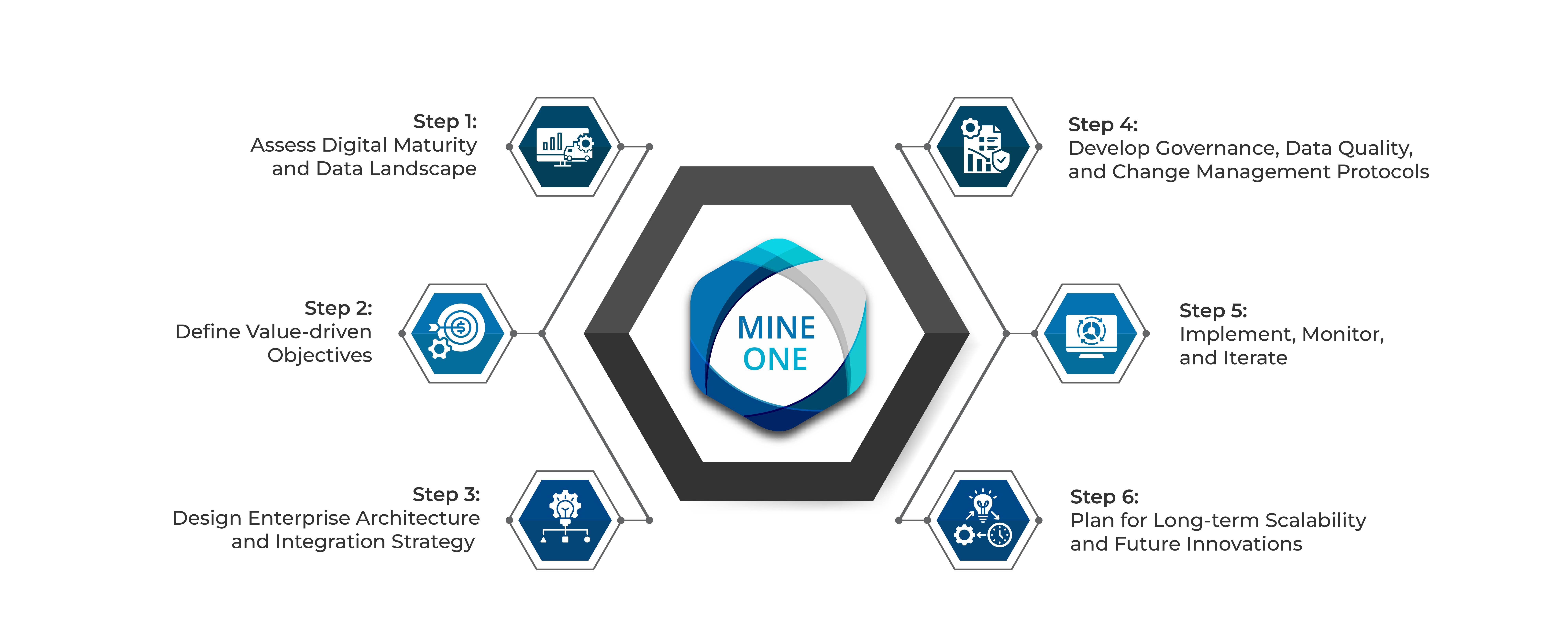
Mining executives ready to transform data silos into strategic decision-making should follow this action plan.
Step 1: Assess Digital Maturity and Data Landscape
Map existing systems comprehensively: ERP platforms, SCADA, fleet management, maintenance, environmental monitoring, and compliance tools. Identify where data fragments and where duplication occurs. Understand current data flows, identify data owners, pinpoint data gaps, and quantify integration challenges. This assessment clarifies where integration provides highest returns.
Step 2: Define Value-driven Objectives
Identify your key pain points. Does low throughput constrain profitability? Do high downtime rates destroy production plans? Does poor maintenance efficiency inflate costs? Does safety compliance consume excessive resources? Does cost per tonne exceed competitive benchmarks? Prioritise initiatives delivering visible early ROI, typically combining production planning plus real-time sensor integration, or maintenance plus fleet dispatch optimisation.
Step 3: Design Enterprise Architecture and Integration Strategy
Select a modular, scalable mine management platform rather than attempting custom integration. Plan phased implementation: pilot critical modules first, integrate legacy systems, test data pipelines, and validate data quality rigorously. Avoid the trap of replacing systems piecemeal; instead, design the architecture supporting your long-term vision.
Step 4: Develop Governance, Data Quality, and Change Management Protocols
Assign clear data ownership. Define processes for data entry, validation, and updates. Implement rigorous data governance ensuring consistent quality across all sources. Train workforce comprehensively; communicate benefits clearly to all levels; embed new workflows into daily operations; and plan for organisational change systematically. Frontline supervisors must see tangible value quickly or adoption falters.
Step 5: Implement, Monitor, and Iterate
Deploy initial modules and use dashboards and KPIs to measure performance continuously. Track production metrics, cost per tonne, safety indicators, compliance status, downtime, and asset utilisation. Refine and expand gradually: once initial modules succeed, onboard additional functions like environmental monitoring, logistics, compliance tracking, and fleet dispatch. Early success builds momentum for broader implementation.
Step 6: Plan for Long-term Scalability and Future Innovations
Incorporate advanced analytics, predictive maintenance, digital twin simulations, and AI-driven forecasting into your roadmap. These innovations keep your operation ahead of emerging challenges and maintain competitive advantage long-term.
Most mining digitalisation solutions available today evolved from addressing a single operational problem. Some originated as fleet management tools, others as maintenance systems, plant control platforms, safety solutions, or reporting layers. While many have added integrations overtime, their underlying architecture remains fragmented. This leaves mining organisations operating with duplicated data, delayed reconciliation, manual workarounds, and inconsistent operational truth across departments.
MineOne™ was designed differently from the outset. It is a unified mine management digitalisation platform built to operate across the entire mine value chain, spanning planning, production, processing, maintenance, safety, compliance, and executive decision-making. Its core design principle is that operational intelligence only becomes strategic when all systems operate on a shared data backbone with real-time contextual awareness. Rather than stitching together siloed tools, MineOne™ establishes a single operational foundation for the mine.
A Unified Digital Backbone Across Mine Operations
MineOne™ functions as a central operational layer that integrates and orchestrates data from SCADA and PLC systems, fleet management platforms, maintenance and asset management tools, environmental monitoring systems, ERP platforms, weighbridges, logistics solutions, and safety systems. Instead of replicating data into disconnected reports, MineOne™ normalises, contextualises, and correlates information across these systems in near real-time.
This unified backbone ensures that production plans reflect actual plant capacity, fleet availability reflects real equipment health, maintenance schedules align with operational demand, and safety and environmental thresholds are embedded directly into daily decision-making. All stakeholders, from shift supervisors to site leadership and executives, work from the same operational truth rather than fragmented or delayed views of performance.
Production Intelligence Embedded, Not Bolted On
Unlike platforms where analytics are layered on after execution, MineOne™ embeds production intelligence directly into operational workflows. Planning, execution, monitoring, reconciliation, and optimisation occur within a single system, eliminating the traditional lag between what was planned, what occurred on the ground, and how decisions are made.
MineOne™ enables short-interval control by continuously comparing plan versus actual performance at equipment, shift, bench, and plant levels. Deviations are detected as they occur, root causes are traceable across systems, and corrective actions can be taken within the same operational window. This fundamentally shifts operations from reactive end-of-shift reporting to real-time operational control.
Rapid Customisability through Devum™: Built for Real Mining Operations
Mining operations vary widely by geography, commodity, mining method, regulatory environment, and organisational structure. Rigid software platforms force operations to adapt to system limitations. MineOne™ avoids this by being built on Devum™, a low-code application platform designed for complex enterprise workflows.
Devum™ enables MineOne™ suite of digitalisation solutions to be customised rapidly to reflect site-specific processes without lengthy development cycles or custom code. New workflows, approval logic, data models, dashboards, integrations, and offline processes can be introduced as operational needs evolve. This ensures MineOne™ scales across sites, adapts to organisational change, and remains aligned with operational reality over time.
Mining environments frequently operate with unreliable or intermittent connectivity. Remote pit locations, underground workings, mobile equipment, and geographically dispersed sites cannot depend on continuous network availability. MineOne™ addresses this reality through robust offline capabilities powered by Devum™.
Critical operational workflows such as inspections, production logging, shift handovers, safety checks, maintenance activities, and approvals continue to function seamlessly even when connectivity is unavailable. Data is captured locally at the edge and automatically synchronised once connectivity is restored, without manual intervention or data loss. This ensures continuity of operations, data integrity, and accurate reconciliation regardless of network conditions.
Importantly, these offline capabilities extend beyond data capture. Business rules, validations, and workflow logic configured through Devum™ continue to operate offline, ensuring operational discipline is maintained even in disconnected environments. Once synchronisation occurs, MineOne™ reconciles offline and online data streams into a single, auditable operational view. This offline-first design is essential for mines operating in remote, underground, or connectivity-constrained environments.
Real-time Operational Intelligence for Every Role
MineOne™ delivers role-specific operational intelligence across the organisation. Supervisors gain real-time visibility into production deviations, equipment constraints, and safety risks. Planners receive continuously updated actuals to refine schedules and forecasts. Maintenance teams access condition-based insights rather than reactive breakdown reports. Executives gain consolidated, real-time views of production performance, cost drivers, risk exposure, and compliance status across sites.
This shared visibility eliminates traditional communication gaps between departments. Decisions are faster, coordination improves, and accountability becomes clearer because every action is supported by consistent, trusted data.
Proven at Scale Across Mining Environments
MineOne™ has been deployed across multi-site mining environments, cross-border fleet operations, and complex industrial contexts where data fragmentation previously limited visibility and control. Case studies demonstratemeasurable improvements in production stability, equipment utilisation, downtime reduction, governance, and decision-making speed.
These outcomes are driven not by automation alone, but by integration, contextual intelligence, and operational alignment. MineOne™ succeeds because it addresses the root cause of underperformance in modern mining: disconnected systems operating without shared context.
Built for the Next Decade of Mining
As mining operations face increasing pressure from cost volatility, ESG compliance, workforce constraints, and rising operational complexity, digital foundations must support long-term adaptability. MineOne™ powered by Devum ™ is designed with capabilities like advanced analytics and visualisation, predictive maintenance, 3D digital twins, AI-driven forecasting, and expanded edge and offline intelligence, without requiring architectural reinvention.
Mining organisations that succeed in the next decade will be those that treat data as a strategic asset rather than an operationalby-product. MineOne™ provides the integrated, resilient digital foundationrequired to turn operational data into sustained competitive advantage.
Conclusion
Modern mine management is defined by the ability to unify data, understand operations in real-time, and translate intelligence into action. Production intelligence provides analytical engine for guiding planning and daily execution. Integrated operations create the data pipelines and contextualisation layers required for visibility and clarity.
When mines overcome data silos, they unlock operational understanding that reshapes productivity, safety, cost control, and strategic readiness. Organisations gain the ability to plan accurately, monitor continuously, adjust rapidly, and grow sustainably. Strategic decisions replace reactive firefighting.
MineOne™ provides the digital architecture required to operate at this level. It delivers the connected environment, configurability, analytics, and real-time visibility that modern mines require. For mines preparing to embrace more integrated, intelligent, and future-ready operational models, now is the time to build the digital foundation that will carry you forward.
Transform your data silos into strategic advantage. Thecompetitive landscape is shifting, and integration is no longer optional.
Reactore MineOne isn’t just a software platform; it’s a game-changer. It transformed our mining operations, making them more efficient, cost-effective, and sustainable. We highly recommend Reactore MineOne to any mining company looking to stay ahead in this competitive industry.
Andrew Coleman
Chief Operations Officer
Global Minerals Corporation
Book a Demo
Experience Minone First-hand!
Thank you! Your submission has been received!
Oops! Something went wrong while submitting the form.
Devum saved our team time and money! Before Devum, software development was slow and expensive. Devum's low-code platform cut development time in half and lowered costs. Their easy-to-use platform and helpful support got us up and running quickly. Now we can focus on innovation and launch products we once thought impossible. Devum is more than just software, it's a partner that helped our business grow.
Alex Rivera
Chief Technology Officer
Innova Digitalisation Systems
Request a FREE Trial
Join the Low-code Revoultion Now. Claim Your FREE Trial!
Thank you! Your submission has been received!
Oops! Something went wrong while submitting the form.
RAMJACK Technology Solutions Having worked closely with the Reactore team over the past 5 years I can attest to their proactive, ‘can-do’ attitude. Not only is the MineOne platform an incredibly powerful tool for the mining industry; the team’s focus on the client’s specific requirements drives closer engagements and a longer lasting relationship. Reactore is fundamental in bringing together and visualising technology integration into a difficult environment
Rupert Birch
Vice President EMENA
RAMJACK Technology Solutions
Get in Touch
Join Hands for a Digital Transformation journey with Reactore!
Thank you! Your submission has been received!
Oops! Something went wrong while submitting the form.
Our partnership with Reactore, established in 2015, has been instrumental in designing and implementing innovative mining compliance systems. Their seamless approach translates complex regulations into user-friendly solutions, ensuring a smooth journey from concept to real-world application. This collaboration has consistently benefited LCS by allowing us to deliver superior value to our clients. Their ability to convert complex concepts into solutions that appear simple to the end user really is the ultimate sophistication!
Jaco Swartz
Managing Director
LCS (Pty.) Ltd.
Become a Partner
Join Our Partner Network
Thank you! Your submission has been received!
Oops! Something went wrong while submitting the form.