How Leading Mines Are Overcoming Digitalisation Challenges in 2026
Chitradip Pramanik
•
February 18, 2026
Digital Transformation
From Understanding the Problem to Acting on It
In our previous blog, Why Mining Digitalisation Fails in Practice, we explored a hard but necessary question: why do so many mining digital transformation initiatives continue to struggle, even in 2026? We examined the structural, organisational, and economic barriers that repeatedly derail progress, from legacy system complexity and capital constraints to skills gaps, silos, and unclear returns on investment.
This second part of the series builds on that foundation.
Rather than revisiting the challenges, this blog focuses on how leading mining companies are responding to them in practice. Across different geographies, commodities, and operating models, some organisations are making measurable progress by rethinking how digitalisation is planned, implemented, and scaled. Their success is not driven by technology alone, but by disciplined execution, organisational alignment, and a clear focus on operational value.
If you have not yet read the first blog, we recommend starting there to understand the context and challenges that set the stage for the practices discussed here. Together, these two pieces aim to provide a complete and grounded perspective on mining digitalisation in 2026: first understanding why it fails, and then examining what actually works.
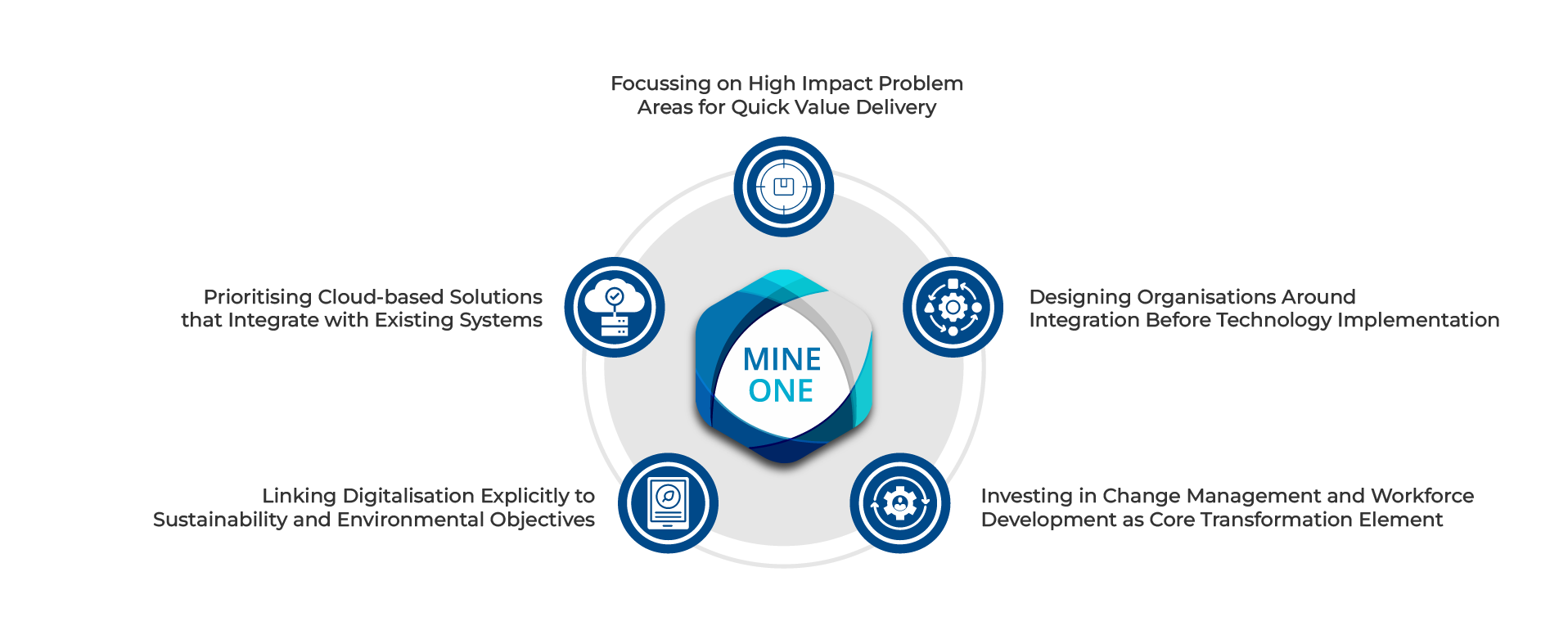
Leading Practice 1: Focusing on High Impact Problem Areas for Quick Value Delivery
The most successful mining digital transformations do not attempt comprehensive system overhauls simultaneously across entire operations. Instead, leading companies identify specific operational bottlenecks where digital solutions can generate significant value quickly, delivering measurable results within 12 to 18 months. This focused approach builds organisational momentum and stakeholder confidence that justifies subsequent transformation phases.
Rio Tinto's autonomous haulage system deployment exemplifies this focused implementation approach, with the company starting pilot projects in 2008 and reaching full autonomy trials by 2015. Rather than attempting to automate entire mining operations across all sites simultaneously, Rio Tinto concentrated initial deployment on remote open-pit mines in the Pilbara region of Western Australia where autonomous equipment could replace dangerous long-haul trucking operations. This focus enabled the company to refine autonomous vehicle systems in controlled environments before scaling to more complex mining scenarios. The successful deployment reduced operator exposure to hazardous conditions whilst improving fuel efficiency and increasing productive equipment utilisation rates.
Another compelling example comes from a major state-owned iron ore mining enterprise that transformed its logistics operations through the strategic deployment of MineOne™, Reactore’s integrated digital mine management platform. The success of this project relied on an integration-first strategy. Built on Reactore’s advanced low-code architecture, Devum™, the platform did not require a wholesale replacement of the mine's legacy infrastructure. Instead, it integrated seamlessly with established systems including SAP ERP, Mine Information Management Systems, SCADA platforms, and equipment telemetry from multiple manufacturers.
By leveraging these standardised APIs to create unified data visibility without disrupting the underlying IT ecosystem, the operation could concentrate its investment strictly on traffic management and dispatch optimisation. Using this focused approach, the enterprise achieved remarkable operational results: annual production increased from 3.85 to 10 million tonnes (a 160% improvement), truck transport capacity expanded to 4,000 to 4,500 vehicles daily (a 72% increase), processing time per truck dropped 98%, and turnaround time fell 81%. Critically, the operation achieved zero fatalities post-implementation despite the substantial increase in traffic volume.
This targeted implementation enabled the operation to demonstrate undeniable value before expanding digitalisation to additional segments. This approach addresses capital constraints more effectively than comprehensive transformation strategies, as focused implementations require modest investment levels that fit within annual capital budgets while generating the internal justification needed for future scaling.
Leading Practice 2: Designing Organisations Around Integration Before Technology Implementation
Successful mining companies restructure organisations to break down functional silos before or simultaneously with digital system deployment. These organisational designs create cross-functional accountability for integrated operational performance rather than function-specific optimisation that undermines overall results.
This restructuring typically involves creating integrated teams where geological, operations, maintenance, and planning expertise work collaboratively. These teams establish shared metrics that reward holistic performance. For instance, a geological team within an integrated structure recognises that ore grade forecasts must account for processing plant constraints, while operations teams understand that production schedules must reflect actual equipment condition. Governance structures are then established to ensure digital insights, such as AI-generated production sequences are evaluated collectively rather than by isolated departments.
Leading mining companies address both organisational silos and capital constraints by adopting modular digital platforms like MineOne™, which are designed to scale incrementally. Its modular architecture enables operations to start with focused solutions and systematically expand capabilities across the pit-to-port value chain as budgets allow.
A leading Bauxite mining company in India illustrates this success. The operation struggled with disjointed manual reporting and siloed departments that obscured the link between extraction and processing. By deploying MineOne™ to create a single source of truth across mining, processing, and logistics, the mine eliminated the friction between functional units. The result was a 20% improvement in grade blending accuracy and about 30% faster dispatch transactions, achieved not by replacing every asset, but by ensuring every department operated from the same real-time data.
This approach provides the structural support needed for organisational transformation. For this, the mine management platform consolidates data from exploration, production, maintenance, and safety into unified dashboards, forcing cross-functional visibility. When geotechnical engineers use real-time monitoring to assess slope stability, production teams immediately see the implications for their schedules. This structural integration creates inevitable cross-functional alignment that manual governance structures struggle to achieve, proving that digital tools can drive both financial ROI and organisational coherence.
Leading Practice 3: Investing in Change Management and Workforce Development as Core Transformation Elements
The most successful mining digital transformations invest substantially in change management and workforce development initiatives. These investments receive comparable capital allocation and senior management attention as the technology investment itself.
This workforce-focused approach includes comprehensive training programmes that develop operator proficiency with new systems before full deployment. Digital twin technology enables operators to develop skills in simulated environments before managing actual equipment underproduction pressure, substantially accelerating learning curves. Successful training moves beyond technical instruction to include change management content that addresses employee concerns about job security, emphasising technology’s role in enhancing rather than replacing human capability.
Leading companies also invest strategically in talent acquisition to address skills gaps systematically. They establish partnerships with educational institutions to develop programmes that prepare students for digital mining careers, whilst offering competitive compensation to attract technology talent. Internally, they create advancement pathways that allow experienced professionals to develop digital expertise through on-the-job learning.
Equally important, leading companies facilitate this transition by deploying digital solutions designed specifically for mining operations rather than generic enterprise applications. MineOne™, developed by Reactore with extensive industry expertise, features role-specific workflows that mining professionals immediately understand. Rather than forcing operations to conform to generic software logic, MineOne™ implements mining operational reality into its system design, featuring intuitive interfaces that reflect actual workflows for engineers, planners, and operators. This mining-centric approach substantially accelerates user adoption, reduces training requirements, and builds workforce confidence that the platform genuinely understands the unique demands of the mining environment.
How Leading Mining Companies are Responding to Digitalisation Challenges
Leading Practice 4: Prioritising Cloud-based Solutions that Integrate with Existing Systems
Rather than requiring wholesale replacement of legacy systems, leading mining companies favour cloud-based digital solutions that integrate with existing applications through standardised interfaces and APIs. This integration approach reduces implementation risk substantially and allows gradual technology evolution as business conditions change and new capabilities emerge.
Cloud-based data platforms serve as integration layers that collect data from multiple legacy systems, standardise data formats into consistent structures, and provide unified analytics access across the entire mining organisation. Rather than forcing mining companies to replace proven legacy applications, cloud platforms work alongside existing systems, gradually taking over functions as legacy systems reach end of life and require replacement. This approach preserves existing capital investments whilst enabling digital capability development.
Cloud platforms also provide flexibility for smaller mining companies that lack capital budgets for complete infrastructure replacement. A mid-tier mining operation can integrate legacy systems with cloud-based analytics and monitoring platforms, developing digital capabilities incrementally as budgets allow. This democratisation of digital capability enables more mining companies to access transformation benefits regardless of size or capital availability.
Enterprise-grade low-code application platforms like DevumTM, provide advantages for mining companies managing complex technology landscapes. MineOne™, built on DevumTM, facilitates rapid customisation and integration without requiring extensive code development. Rather than engaging expensive system integrators for months-long implementation projects, mining operations can configure MineOne™’s standardised modules to match their specific workflows through intuitive visual development interfaces. This approach accelerates deployment timelines, reduces dependency on scarce development resources, and enables rapid adaptation as operational requirements evolve.
Leading Practice 5: Linking Digitalisation Explicitly to Sustainability and Environmental Objectives
To overcome scepticism regarding financial ROI, leading mining companies connect digital transformation explicitly to environmental and sustainability objectives. This strategy addresses the capital constraint challenge by creating a dual value proposition: digital systems reduce environmental impact whilst simultaneously improving operational efficiency.
Autonomous equipment optimises fuel consumption, reducing energy costs and greenhouse gas emissions. AI systems reduce waste generation through improved ore processing efficiency, whilst predictive maintenance minimises energy waste from inefficient equipment. This linkage attracts capital from investors focused on Environmental, Social, and Governance (ESG) performance, who increasingly favour mining companies demonstrating genuine commitment to responsible operations.
Solutions like MineOne™ directly support this dual objective. For instance, by implementing MineOne™’s fleet management module with real-time fuel monitoring and driver behaviour analytics, one operation achieved a 90% reduction in unauthorised fuel losses alongside a 40% reduction in safety incidents. This demonstrates how digital tools can deliver immediate financial returns through efficiency — addressing the ROI barrier — while simultaneously advancing sustainability goals. By framing digitalisation as a sustainability enabler, mining companies can justify larger investments to capital providers and regulators, ensuring that digital transformation creates value beyond the balance sheet.
Critical Success Factors for Mining Digitalisation Initiatives in 2026
Mining companies pursuing digital transformation in 2026 should follow a structured implementation framework that systematically addresses the barriers documented above whilst leveraging leading practice approaches that have demonstrated success.
This framework is not theoretical; it is derived directly from years of collaboration with Reactore’s diverse client base. By observing where mining operations struggle and where they succeed, we have distilled a practical, four-phase roadmap that prioritises value delivery and organisational health over technology for technology’s sake.
Critical Success Factors for Mining Digitalisation Initiatives
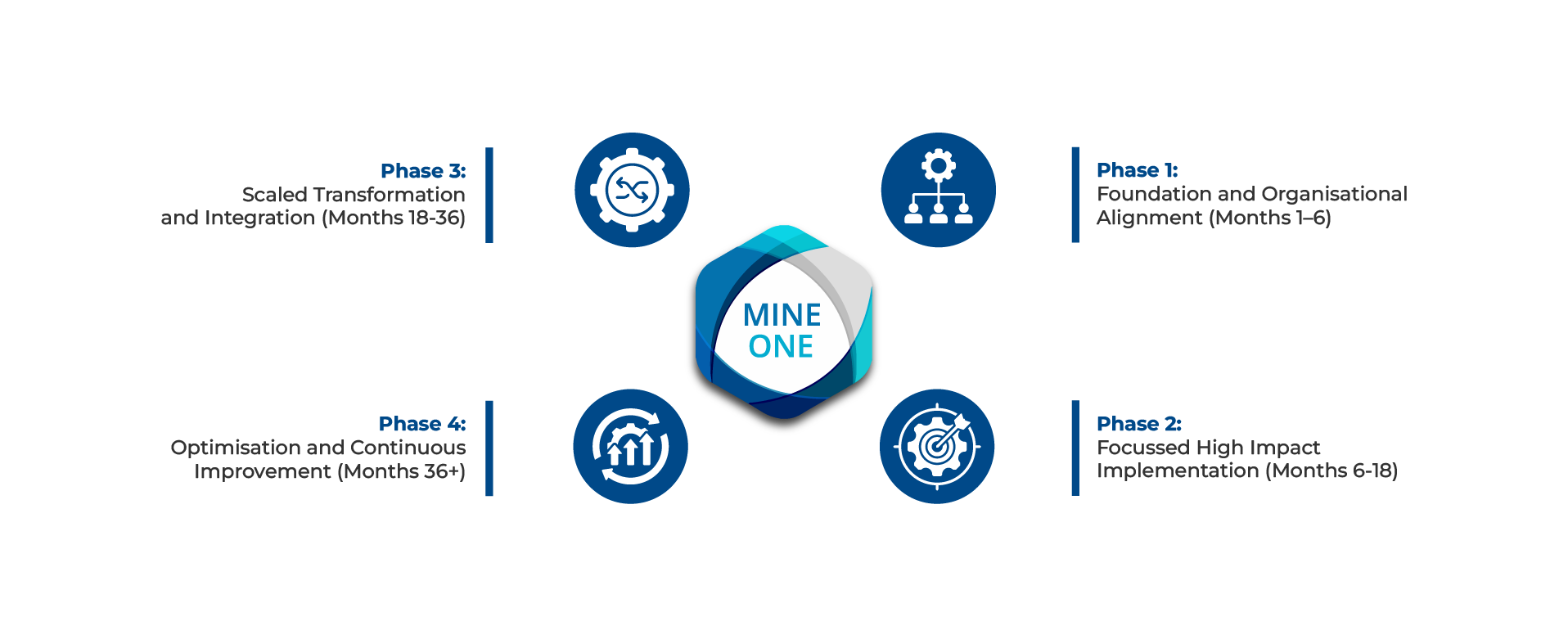
Phase 1: Foundation and Organisational Alignment (Months 1-6)
Begin by breaking down functional silos and establishing cross-functional governance. Conduct a comprehensive audit of existing legacy systems and workforce capabilities to identify integration gaps and training needs. Rather than planning a "rip and replace" overhaul, evaluate flexible integrated platforms like MineOne™ that support phased implementation. Use this period to set realistic ROI expectations based on specific, measurable operational metrics.
Phase 2: Focused High Impact Implementation (Months 6-18)
Avoid boiling the ocean. Select high-impact bottlenecks such as traffic dispatch or fleet management. Here digital solutions can generate measurable value quickly. Implement a cloud-based integration layer to consolidate data from legacy systems, deploying focused MineOne™ modules to address these specific pain points. Accompany this rollout with intensive, role-specific workforce training to ensure immediate adoption and build stakeholder confidence.
Phase 3: Scaled Transformation and Integration (Months 18-36)
Leverage the wins from Phase 2 to justify broader scaling. Expand the integrated platform to encompass additional systems, commodity streams, and advanced capabilities like digital twins. Continue to add MineOne™ modules incrementally, building on the established data foundation. This modular approach allows for steady expansion across the pit-to-port value chain as budgets and operational readiness permit, ensuring that technology growth never outpaces workforce proficiency.
Phase 4: Optimisation and Continuous Improvement (Months 36+)
Shift focus from implementation to refinement. Analyse performance against baselines to identify new optimisation opportunities. Utilise the platform’s extensibility to integrate emerging technologies such as advanced AI and autonomous systems, as and when they mature. Maintain a cycle of continuous workforce development and system configuration to ensure the digital ecosystem evolves alongside the mine’s operational reality.
Critical Success Factors for Mining Digitalisation Initiatives
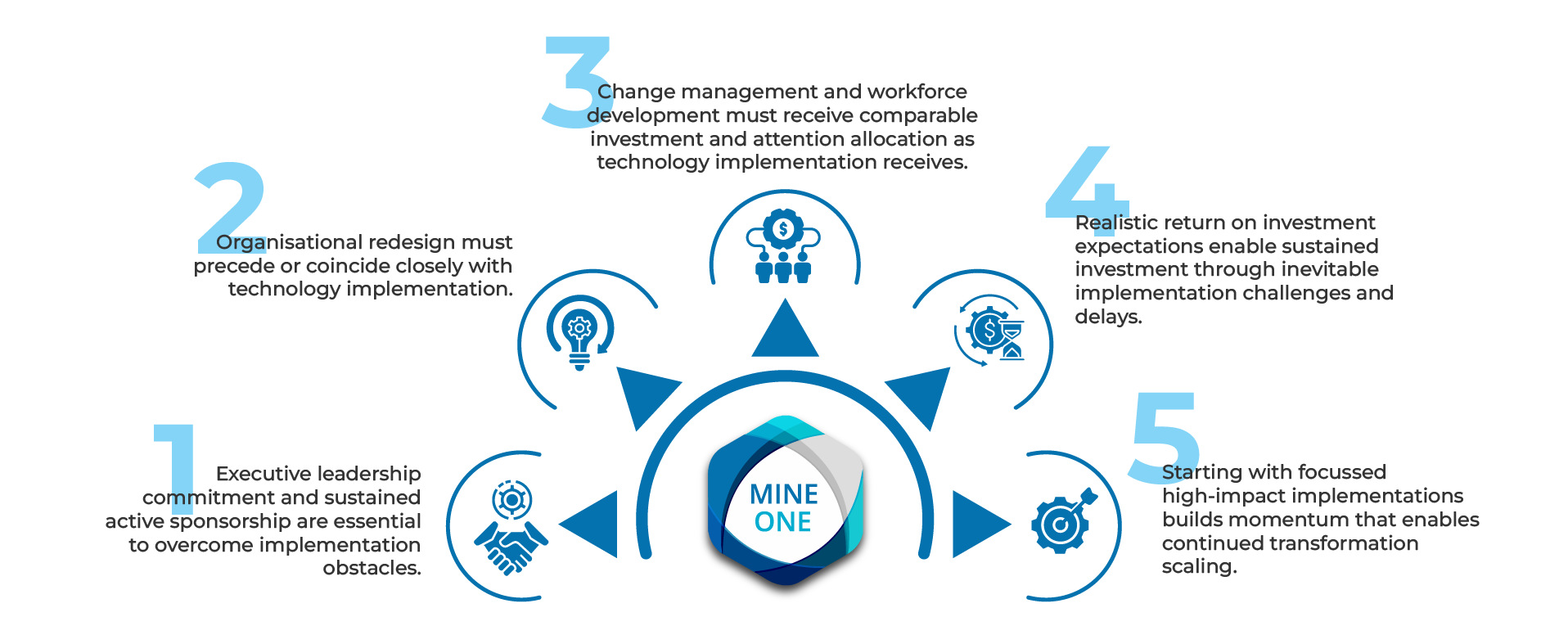
Mining organisations pursuing digital transformation should prioritise five critical success factors that research and industry experience consistently identify as decisive for implementation success:
First, executive leadership commitment and sustained active sponsorship are essential to overcome implementation obstacles. Digital transformation cannot succeed as a technology initiative managed by information technology departments alone. Transformation requires active engagement from mining company executive leadership that explicitly connects digital transformation to overall business strategy and allocates adequate capital and human resources.
Second, organisational redesign must precede or coincide closely with technology implementation. Technology alone cannot resolve organisational dysfunction that undermines decision-making. Mining companies must consciously restructure organisations to break down functional silos and create integrated accountability before implementing new digital systems.
Third, change management and workforce development must receive comparable investment and attention allocation as technology implementation receives. Digital systems remain unutilised tools if workforces lack proficiency or actively resist adoption. Successful transformation requires substantial investment in training, change management, and talent development programmes.
Fourth, realistic return on investment expectations enable sustained investment through inevitable implementation challenges and delays. Overpromised benefits create disappointment that discourages continued investment. Realistic projections tied to specific operational metrics build credibility and support continued digitalisation. Case study evidence from comparable mining operations implementing proven platforms like MineOne™ provides essential credibility for ROI projections.
Fifth, starting with focused high-impact implementations builds momentum that enables continued transformation scaling. Attempting comprehensive system overhauls simultaneously creates unmanageable complexity. Focused implementations deliver measurable results that justify subsequent transformation expansion. Platforms designed for modular, phased implementation such as MineOne™ enable this incremental approach aligned with capital availability and organisational readiness.
Critical Success Factors for Mining Digitalisation Initiatives
Conclusion: Turning Digital Intent into Operational Reality
Mining digitalisation does not succeed by accident. As the practices outlined in this blog demonstrate, progress comes from deliberate choices: focusing on high-impact problems, designing organisations around integration, investing in people as much as technology, and adopting platforms that support phased, practical execution.
These approaches directly address the barriers discussed in the first part of this series. Legacy complexity is reduced through integration-first thinking. Capital constraints are managed through focused, modular deployment. Workforce resistance is addressed through mining-centric design and change management. Silos are broken by creating shared operational visibility. ROI improves when digitalisation is tied to execution rather than isolated optimisation.
Taken together, these practices show that digital transformation in mining is not about chasing the latest technology trend. It is about building the operational foundations that allow technology to deliver sustained value over time.
As the industry continues to face declining ore grades, rising complexity, and increasing scrutiny on safety and sustainability, the ability to execute digitalisation effectively will increasingly separate leading mines from those that fall behind. For mining organisations in 2026, the question is no longer whether to pursue digital transformation, but how deliberately and practically it is carried out.
Reactore MineOne isn’t just a software platform; it’s a game-changer. It transformed our mining operations, making them more efficient, cost-effective, and sustainable. We highly recommend Reactore MineOne to any mining company looking to stay ahead in this competitive industry.
Andrew Coleman
Chief Operations Officer
Global Minerals Corporation
Book a Demo
Experience Minone First-hand!
Thank you! Your submission has been received!
Oops! Something went wrong while submitting the form.
Devum saved our team time and money! Before Devum, software development was slow and expensive. Devum's low-code platform cut development time in half and lowered costs. Their easy-to-use platform and helpful support got us up and running quickly. Now we can focus on innovation and launch products we once thought impossible. Devum is more than just software, it's a partner that helped our business grow.
Alex Rivera
Chief Technology Officer
Innova Digitalisation Systems
Request a FREE Trial
Join the Low-code Revoultion Now. Claim Your FREE Trial!
Thank you! Your submission has been received!
Oops! Something went wrong while submitting the form.
RAMJACK Technology Solutions Having worked closely with the Reactore team over the past 5 years I can attest to their proactive, ‘can-do’ attitude. Not only is the MineOne platform an incredibly powerful tool for the mining industry; the team’s focus on the client’s specific requirements drives closer engagements and a longer lasting relationship. Reactore is fundamental in bringing together and visualising technology integration into a difficult environment
Rupert Birch
Vice President EMENA
RAMJACK Technology Solutions
Get in Touch
Join Hands for a Digital Transformation journey with Reactore!
Thank you! Your submission has been received!
Oops! Something went wrong while submitting the form.
Our partnership with Reactore, established in 2015, has been instrumental in designing and implementing innovative mining compliance systems. Their seamless approach translates complex regulations into user-friendly solutions, ensuring a smooth journey from concept to real-world application. This collaboration has consistently benefited LCS by allowing us to deliver superior value to our clients. Their ability to convert complex concepts into solutions that appear simple to the end user really is the ultimate sophistication!
Jaco Swartz
Managing Director
LCS (Pty.) Ltd.
Become a Partner
Join Our Partner Network
Thank you! Your submission has been received!
Oops! Something went wrong while submitting the form.